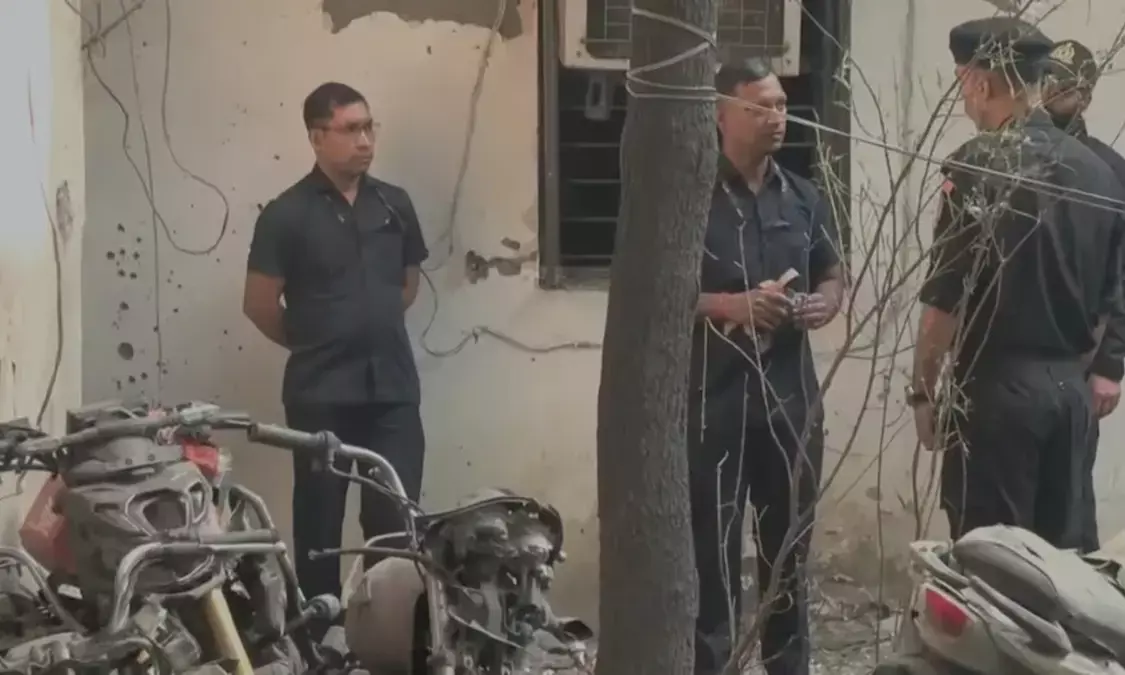
A powerful explosion ripped through the perimeter of the Vasundhara police outpost in Ghaziabad, Uttar Pradesh, triggering widespread panic across the bustling National Capital Region (NCR) hub and placing state security apparatuses on high alert. The blast, which occurred along the rear boundary wall of the facility under the Indirapuram police station jurisdiction, shattered windowpanes, caused structural fissures, and left a delivery worker injured.
Within hours of the incident, the narrative took an alarming turn when a social media account operating under the banner of an outfit calling itself Tehreek-ul-Mujahideen Hindustan claimed responsibility for the strike. While central and state intelligence agencies—including the Uttar Pradesh Anti-Terrorism Squad (UP ATS)—scrutinize the digital footprint and physical forensic samples, the incident has exposed emerging fault lines in urban infrastructure security.
The Incident: Nighttime Detonation in an Urban Artery
The incident occurred late in the evening around 9:00 PM, an hour when vehicular transit and pedestrian footfall remain elevated along the arterial corridors of Vasundhara. The police post is situated at a strategic node connecting Ghaziabad to neighboring Indirapuram, adjacent to key flyovers and elevated transit passages that connect Western Uttar Pradesh to East Delhi.
According to preliminary accounts from the Ghaziabad Police Commissionerate, a duty Sub-Inspector and an e-commerce delivery rider were present within the compound when a deafening blast detonated just behind the post’s rear wall. The sheer force of the detonation blew out the glass panes of multiple windows and caused visible cracks across the brick masonry. The delivery boy, who had pulled over to complete a routine drop-off, sustained shrapnel and blunt-impact injuries and was rushed to a nearby hospital for emergency treatment.
Emergency units, field forensic teams, and the local Bomb Disposal Squad (BDS) cordoned off the entire perimeter within minutes, setting up multi-layered barricades and diverting local traffic.
The Shadowy Claim: Tehreek-ul-Mujahideen Hindustan
Before investigators could determine whether the explosion originated from an explosive device, a chemical accelerant, or a pressurized canister, an unverified post began circulating on social media.
Uploaded from an account associated with “Ghazi 2” and amplified across messaging channels, the statement proclaimed that Tehreek-ul-Mujahideen Hindustan had carried out the blast, terming it a retaliatory operation directed at law enforcement personnel.
The claim immediately activated senior counters-terror desks for several reasons:
- Nomenclature and Lineage: Historically, the Tehreek-ul-Mujahideen (TuM) was a Pakistan-backed terror group active in Jammu and Kashmir, formally designated and banned under India’s Unlawful Activities (Prevention) Act (UAPA) in 2019. However, the suffix “Hindustan” points to a potentially synthetic front or a new digital moniker.
- Proxy Strategies & Disinformation: Modern hybrid terror modules frequently deploy newly coined names or opportunistic claims to amplify panic, exaggerate operational footprint, and mislead security agencies. Investigators note that foreign handler networks—specifically elements tied to Pakistan’s Inter-Services Intelligence (ISI) and cross-border criminal conduits like the Shehzad Bhatti syndicate—often use disposable fronts to obfuscate the real actors.
- Absence of Immediate Residue: Curiously, initial spot reports from the Bomb Disposal Squad and forensic specialists noted that standard explosive residues, such as high-grade nitrates, RDX traces, or conventional gunpowder, were not immediately identifiable at the primary point of impact. This raises two operational possibilities: either a crude low-explosive concoction was utilized, or the online claim is a tactical piggyback designed to exploit a localized, accidental failure (such as an air conditioner compressor or gas cylinder rupture) to foster psychological terror.
Multi-Agency Probe Mobilized
Given the geographic sensitivity of Ghaziabad—bordering the National Capital Territory of Delhi—the response has been swift and multi-pronged:
- Forensic and Chemical Analysis: Soil scrapings, shattered glass, structural fragments, and dust residue from the rear boundary wall have been sent to state forensic laboratories. Chemical spectrometry will determine whether pyrotechnic precursors, improvised fuel-oxidizer mixes, or military-grade propellants were involved.
- Digital Forensics and Cyber Tracking: Cyber Cell operatives and central intelligence units are tracing the IP addresses, metadata, routing nodes, and VPN proxies used by the social media handles that published the claim. Identifying the geographic origin of the posts will clarify whether the claim originated domestically or was disseminated from servers abroad.
- CCTV & Route Reconstruction: Law enforcement agencies are parsing through hundreds of hours of surveillance footage from CCTV cameras installed on commercial buildings, residential apartment complexes, and traffic junctions surrounding the Vasundhara outpost. Investigators are cross-referencing all vehicle registrations and pedestrian movements noted in the 60-minute window preceding the 9:00 PM blast.
Ghaziabad Police Commissioner J. Ravinder Goud cautioned against jumping to premature conclusions, emphasizing that while every terror angle is being rigorously evaluated alongside the UP ATS, public order depends on empirical forensic verification.
Security Ramifications Across the NCR
The incident comes against a backdrop of heightened alerts issued across North India. Over recent months, anti-terror agencies in Uttar Pradesh and neighboring states have busted multiple decentralized sleeper cells planning strikes on public infrastructure and uniformed personnel. High-ranking police leadership, including UP Additional Director General of Police (Law and Order) Amitabh Yash, had earlier flagged persistent efforts by external adversaries to sponsor lone-wolf or low-cost subversive acts against state symbols.
Targeting a police outpost—a visible, frontline emblem of civic law enforcement—serves a symbolic purpose in asymmetric doctrine. Even when a strike causes minimal structural destruction, striking an installation tasked with civilian protection generates psychological disruption far exceeding the physical blast radius.
In response to the Vasundhara incident, local administrations across Ghaziabad, Noida, Meerut, and the Delhi border checkpoints have stepped up physical checks, initiated random vehicle inspections, and increased armed patrols around local chowkis (outposts) and police stations.
The Vasundhara outpost blast highlights the dual-front challenge facing modern urban policing: physical containment and information warfare.
If forensic testing reveals an intentional improvised explosive device (IED), it will confirm an attempt to breach NCR security rings, necessitating a sweeping counter-terror sweep across regional networks. Conversely, if the blast is identified as an accidental failure seized upon by digital propagandists, it highlights the growing weaponization of online disinformation to induce panic.
Until the forensic laboratories deliver their chemical verdicts and cyber teams pinpoint the origins of the digital claims, Ghaziabad remains on alert, balancing systematic investigation with heightened vigilance along its borders.
About The Author