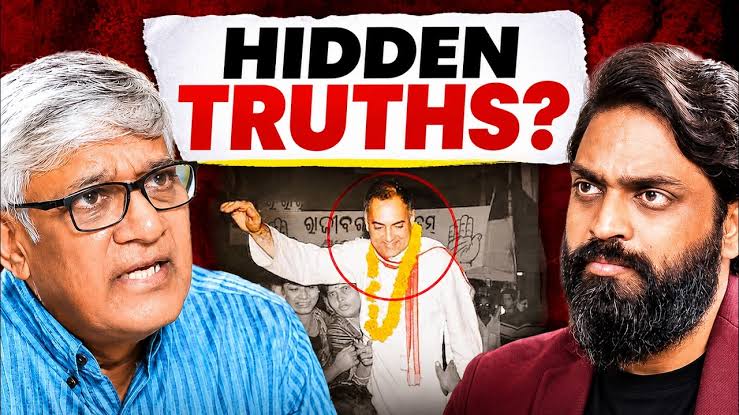
On the sultry night of May 21, 1991, in Sriperumbudur, Tamil Nadu, a blast ripped through the election campaign rally of former Prime Minister Rajiv Gandhi. An improvised explosive device packed with RDX, steel ball bearings, and strapped to a woman known as Dhanu detonated in a flash of blind fire. The attack took the lives of Gandhi, the suicide bomber, and fourteen others, leaving the world’s largest democracy paralyzed with shock.
Officially, the case was resolved with textbook efficiency. The Central Bureau of Investigation (CBI) established a Special Investigation Team (SIT) under D.R. Kaarthikeyan. Within months, the perpetrators were identified as operatives of the Liberation Tigers of Tamil Eelam (LTTE), led by Velupillai Prabhakaran and intelligence chief Pottu Amman. The plot was characterized as an act of calculated revenge for India’s military intervention through the Indian Peace Keeping Force (IPKF) and a preemptive strike to prevent Rajiv’s return to power.
Yet behind the neat narrative upheld in courtroom convictions lies an unsettling reality. Decades later, judicial inquiries, whistleblowing memoirs by frontline investigators, and declassified testimonies suggest that the investigation stopped right at the shoreline of Sri Lanka. The deeper political, financial, and intelligence networks—the “larger conspiracy”—were shielded from view, leaving behind a trail of buried leads and systemic silences.
The Stripping of the Security Shield
The vulnerability that made the Sriperumbudur assassination possible began long before Rajiv Gandhi landed in Tamil Nadu. Following the 1989 general election, when Gandhi lost power, the newly formed National Front government under V.P. Singh took the controversial decision to withdraw his Special Protection Group (SPG) cover. The official justification was legislative: the SPG Act technically provided protection only to the sitting Prime Minister.
Despite persistent warnings from the Intelligence Bureau (IB) that Gandhi was the most targeted political figure in South Asia, the security apparatus downgraded his protection to Delhi Police personnel and local state forces. When the Justice J.S. Verma Commission submitted its report in 1992 investigating the security lapses, it concluded that the standard security norms had been severely flouted and that Gandhi’s protection had been fatally compromised.
Curiously, the P.V. Narasimha Rao government initially rejected the Verma Commission’s findings. While local organizers were blamed for permitting crowds to breach the perimeter, the higher bureaucratic and political machinery that dismantled Gandhi’s protective perimeter was never held accountable.
The Missing Video and Suppressed Evidence
One of the most jarring anomalies in the aftermath was the handling of critical on-site evidence. A local freelance photographer, Haribabu, had been hired by the assassination module to capture the event. Though Haribabu died in the blast, his Chinon camera survived intact. The undeveloped roll inside documented the final moments: the smiling bomber Dhanu holding a sandalwood garland, alongside conspirators Sivarasan and Subha.
However, Haribabu’s camera was not the only visual record. Years later, K. Ragothaman, the chief investigating officer of the CBI-SIT, made a startling disclosure in his book Conspiracy to Kill Rajiv Gandhi: From the CBI Files. Ragothaman revealed that a high-ranking intelligence official had intercepted a video cassette of the Sriperumbudur rally that captured the crowd dynamics and the assassin’s approach from a different, clearer angle.
According to Ragothaman, this video was delivered to the Intelligence Bureau and subsequently vanished. When investigators attempted to pursue the lead, internal pressure ensured the matter was shelved. Why would evidence documenting the exact physical approach of the assassin be withheld from the field investigators? To this day, the tape has never surfaced.
The Unexamined Financial Web: The Godman and the Arms Dealers
In August 1991, under immense public pressure, the Indian government established the Justice M.C. Jain Commission of Inquiry to investigate the “larger conspiracy” and determine whether other individuals or agencies orchestrated the assassination alongside the LTTE.
The Jain Commission’s multi-volume report, tabled in Parliament in 1998, cracked open a geopolitical can of worms. It pointed fingers toward international actors, clandestine financiers, and controversial godman Chandraswami. Chandraswami was well known for his ties to global arms dealers, intelligence fixers, and high-ranking politicians across the globe. Evidence surfaced suggesting shadowy financial transactions linked to LTTE-affiliated bank accounts through London and Southeast Asia.
The commission explicitly recommended investigating Chandraswami’s financial pipelines and his connections to foreign intelligence agencies. Yet, when the Multi-Disciplinary Monitoring Agency (MDMA)—composed of representatives from the CBI, RAW, and IB—was set up in 1998 to pursue these international angles, the investigation crawled at an imperceptible pace. Letters Rogatory sent to half a dozen countries lingered without resolution, witnesses aged or died, and the trail was quietly allowed to run cold.
The Silence of Konanakunte
The operational manhunt ended in August 1991 in a quiet suburb of Bangalore called Konanakunte. The mastermind of the operational cell, Sivarasan—known as the “one-eyed Jack”—along with Subha and five others, were cornered in a rented safe house.
What followed remains an enduring mystery in counter-terrorism operations. The house was surrounded by local police and SIT operatives for nearly two days. Instead of an immediate breach using stun grenades or incapacitating tear gas to take the operatives alive, authorities delayed the assault while awaiting elite National Security Guard (NSG) commandos from Delhi. By the time the raid was initiated, Sivarasan had shot himself in the temple, and his companions had ingested cyanide capsules.
The primary coordinator who held every secret—who funded them, who gave the final order, and what political safe houses they relied upon—took his secrets to the crematorium. A critical question remains unanswered: was the delay in Bangalore a tragic bureaucratic failure, or was it a deliberate stall to ensure Sivarasan never spoke on a witness stand?
A Convenient Endpoint
In 1999, the Supreme Court of India finalized the convictions, confirming death sentences for four individuals (later commuted to life imprisonment) and life terms for others, before they were ultimately released in 2022 after serving over three decades in prison. The legal machinery closed its books.
The official narrative settled comfortably on the ground operatives: local sympathizers, logistical couriers, and suicide bombers. By limiting the scope of the criminal trial strictly to the perpetrators who built and carried the bomb, the state avoided answering questions about the systemic intelligence failures, the deliberate downgrading of security, the suppressed video evidence, and the shadowy financial backers who operated far beyond the jungles of Jaffna.
The Rajiv Gandhi case succeeded as a forensic manhunt, but failed as an inquiry into geopolitical conspiracy. The triggermen and field operatives were identified and penalized, but the deeper architecture of the assassination remains buried beneath redacted dockets and classified files.
About The Author