For years, the experience of ordering food online came with an invisible wall. No matter how much you craved an authentic plate of biryani from a legendary old-city kitchen, a delicate pastry from a boutique patisserie across town, or artisanal ramen from the opposite corner of the metropolis, delivery platforms had a strict limit. Most orders were tethered to a hyper-local perimeter—typically restricted to an operational radius of 7 to 10 kilometers. If your favorite restaurant sat on the other side of the urban sprawl, your options were clear: embark on an hour-long commute through gridlocked traffic or settle for whatever was cooking nearby.
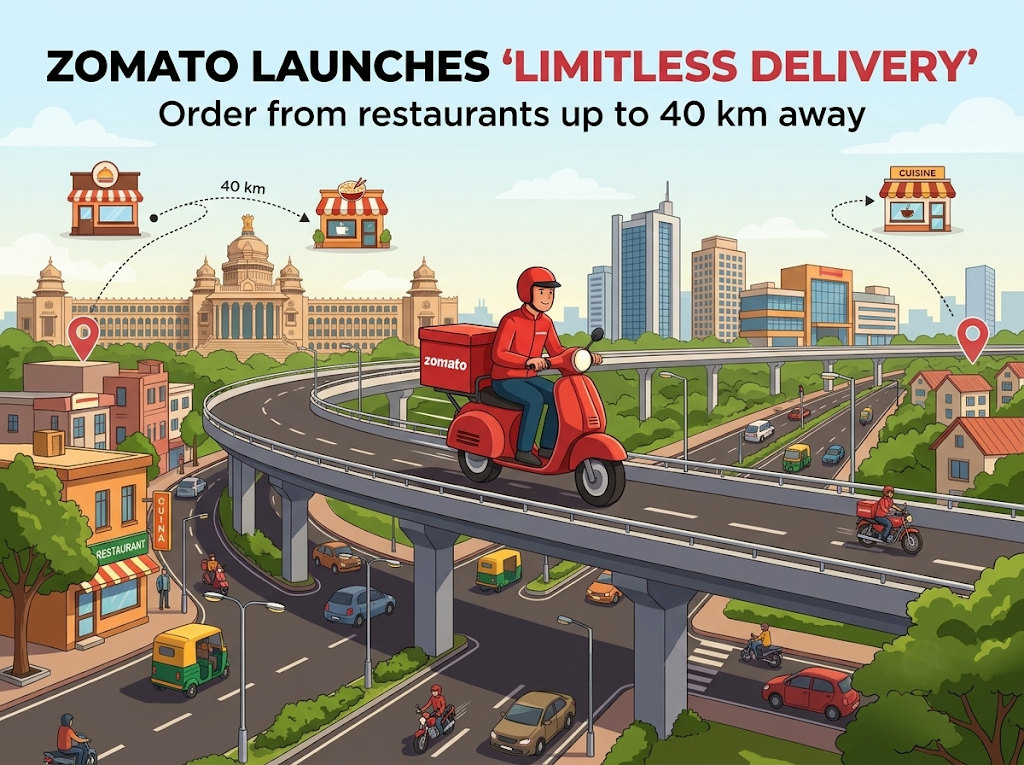
Zomato is dismantling that constraint. In a major shift that redefines hyper-local logistics, the food-tech giant has officially launched Limitless Delivery. The feature allows customers to order dishes from participating restaurants located up to 40 kilometers away within the boundaries of their city.
Rolled out across seven of India’s largest metropolitan hubs—Bengaluru, Delhi NCR, Chennai, Mumbai, Kolkata, Pune, and Hyderabad—Limitless Delivery turns what was once an intractable urban distance into an accessible everyday dining choice.
Breaking Free from the Hyper-Local Cage
Food delivery platforms in India were built around the mechanics of density and rapid turnaround. Fleet optimization algorithms prioritized short distances: pick up an order, drop it off within three to five kilometers, and immediately take another run. This framework powered the rise of 30-minute delivery promises and kept fleet productivity humming, but it created culinary blind spots across expansive tier-one cities.
In rapidly expanding metropolises, real life does not stay inside a single zip code. A young professional living in Whitefield, Bengaluru, might have spent years eating in Indiranagar or Koramangala. A family residing in Gurugram or Noida frequently longs for the iconic kebabs or street food gems of Old Delhi or Connaught Place. In Mumbai, the distance between South Bombay’s heritage cafes and the bustling residential suburbs of the Western Line spans dozens of kilometers, separated by congested expressways.
As cities expanded outwards, suburban diners were often isolated from the culinary heritage concentrated in historic centers or specialized hospitality districts. Zomato’s Limitless Delivery addresses this gap directly. As Zomato CEO Aditya Mangla noted upon launch, customers frequently have favorite eateries situated far from where they live, and expanding order reach up to 40 kilometers provides an uncomplicated way to make an entire city’s culinary landscape accessible to everyone.
How Limitless Delivery Works
The feature is seamlessly integrated directly into the standard Zomato mobile application, requiring no separate platform or complex opt-in process. Users can engage with the expanded radius in two primary ways:
- Curated Exploration: On the Zomato app homepage, users will spot a dedicated Limitless Delivery shortcut placed under the “Explore More” section. Tapping this hub surfaces an algorithmic, curated showcase of iconic and popular restaurants across the city that have opted to deliver over long distances.
- Direct Search Discovery: If a user has a specific institution in mind, they can simply type the restaurant’s name into the universal search bar. If the outlet participates in the program and falls within the 40-kilometer perimeter of the customer’s delivery address, it appears as an orderable option with standard checkout workflows.
Seven Metros, One Shared Appetite
The decision to debut the feature across Bengaluru, Delhi NCR, Chennai, Mumbai, Kolkata, Pune, and Hyderabad is deliberate. These seven urban clusters represent not only the densest food-delivery markets in the country, but also the most geographically fragmented.
- Delhi NCR: The inclusion of the National Capital Region is particularly notable. Spanning borders across Delhi, Gurugram, Noida, and Ghaziabad, NCR has historically suffered from cross-regional delivery silos. With 40 km coverage, the distance between south-eastern satellite hubs and central culinary landmarks suddenly shrinks.
- Bengaluru & Pune: Driven by massive IT corridors located along outer peripheral rings, tech workers residing in outskirts like Electronic City, Sarjapur, or Hinjawadi can now tap into the heritage diners, micro-bakeries, and cultural staples of the central quarters.
- Mumbai & Kolkata: In linear or river-divided metros where traveling north-to-south or crossing water bridges involves substantial transit time, access to long-distance iconic kitchens without braving local trains or bottlenecks changes how households plan weekend meals.
- Chennai & Hyderabad: From authentic Hyderabadi Haleem and Biryani purveyors spread between Old Hyderabad and Hitec City to Chennai’s coastal and suburban splits, long-distance reach reconnects patrons with ancestral recipes irrespective of residential shifts.
Behind the Scenes: The Logistics and Culinary Tightrope
While extending a map radius to 40 kilometers sounds simple on a smartphone screen, it presents immense logistical and operational challenges behind the scenes.
Thermal Integrity and Food Preservation
Unlike standard grocery drops or e-commerce parcels, prepared food is perishable, temperature-sensitive, and prone to textural degradation. A delicate dosa turns soggy within fifteen minutes of steam trap; French fries lose their crispness; hot curries separate if left shaking on a motorcycle rack over dozens of kilometers. To make 40-kilometer deliveries viable, participating restaurants must rethink packaging solutions, leaning into insulated containers, vacuum seals, and vented boxes that safeguard temperature and texture across prolonged journeys.
Route Dynamics and Fleet Allocation
A delivery partner completing a 35-to-40-kilometer run is effectively taken out of the hyper-local rotation for over an hour. Platforms must factor in dead-mileage costs—ensuring delivery riders are adequately compensated for long journeys and can be matched with return trips or higher incentives rather than returning empty-handed.
Transparent Expectations: Delivery Time and Pricing
Long-haul delivery necessarily alters user expectations around fulfillment times and billing. Unlike the instant gratification of 20-to-30-minute delivery, cross-city orders naturally demand patience, often taking an hour or more depending on traffic density. Customers are encouraged to review their checkout screens carefully, where variable delivery fees, distance surcharges, and estimated arrival windows reflect the complexity of spanning whole cities.
The Broader Industry Implication
Limitless Delivery signals a crucial evolution in the food delivery ecosystem. For years, the industry’s primary battlefield was pure speed—culminating in the fierce rise of 10-minute grocery models and rapid commerce.
However, fine dining, regional specialities, and heritage cuisines do not compete on mere velocity; they compete on exclusivity, sentiment, and culinary authenticity. A consumer willing to order an elaborate family feast from a beloved 70-year-old landmark restaurant is happy to wait 60 minutes for dinner, provided the food arrives intact and fresh. By opening a 40-kilometer pipeline, Zomato recognizes that while routine daily staples demand speed, experiential dining demands breadth.
For restaurant partners, this dramatically widens their total addressable market without requiring them to lease expensive real estate to open secondary satellite kitchens or cloud outlets in far-flung suburbs. An independent legacy restaurant in central Kolkata or South Mumbai can now monetize demand across the entire geographic footprint of the city.
By turning urban geography into a unified dining room, Zomato’s Limitless Delivery marks a transition from purely local fulfillment to a true city-wide culinary marketplace. The physical miles remain, but the culinary borders that divided our cities are rapidly disappearing.
About The Author