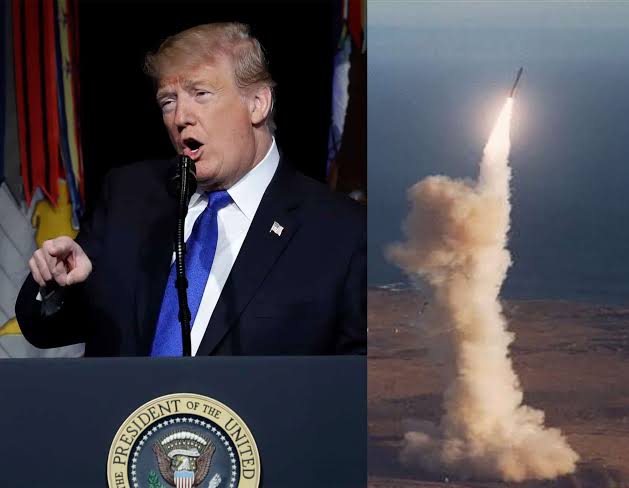
Few questions in constitutional law and national defense provoke as much public anxiety and debate as the extent of presidential control over the American nuclear arsenal. Whenever Donald Trump has occupied or campaigned for the Oval Office, his unconventional communication style and transactional approach to international statecraft have frequently reignited a fundamental national security question: Can President Trump really, unilaterally authorize a nuclear strike?
The short, legally grounded answer is yes. Under existing United States constitutional doctrine, federal law, and Cold War–era command-and-control procedures, the President of the United States exercises sole, unconstrained authority to order the launch of nuclear weapons. Yet the mechanisms that turn that executive impulse into fiery reality are governed by a complex, tightly synchronized operational apparatus designed to balance immediate deterrence with legal legitimacy.
The Doctrine of Sole Authority
To understand whether Trump—or any president—can launch a nuclear strike, one must examine why the system was engineered to concentrate such unprecedented power in a single individual.
During the dawn of the atomic age, President Harry S. Truman consciously wrestled control of atomic weaponry away from military generals, establishing the core precedent that civilian leadership must maintain final authority over nuclear employment. As the Cold War intensified in the late 1950s and 1960s, the emergence of intercontinental ballistic missiles (ICBMs) compressed potential reaction times to mere minutes. Soviet missiles launched over the Arctic or from submarines lurking off the Eastern Seaboard could strike Washington in under fifteen to thirty minutes.
Because deterrence required an adversary to believe that an American retaliation would be instantaneous and devastating, committee deliberation was deemed a strategic liability. A system requiring congressional debate or Cabinet consensus would collapse under the temporal constraints of an imminent nuclear barrage. Consequently, the American National Command Authority was structured so that the Commander-in-Chief alone makes the final determination.
The President does not need permission from Congress, the Secretary of Defense, the Chairman of the Joint Chiefs of Staff, or the Supreme Court to order a strike.
How the Launch Process Operates
Contrary to popular culture tropes, there is no literal “red button” on the Resolute Desk in the Oval Office. The actual operational chain relies on an integrated system of identity authentication, standardized execution orders, and rapid transmission.
1. The Briefcase and the Biscuit
Wherever the President travels, an assigned military aide carries an aluminum-framed, leather-encased zero-Halliburton briefcase commonly known as the “nuclear football”. Inside the football are communications gear and secure reference binders—often called the Black Book—outlining pre-formulated retaliatory options, varying from surgical strikes to comprehensive counter-force and counter-value responses.
Separately, the President is required to carry the “biscuit,” a plastic laminate card containing the daily authentication ciphers known as the Gold Codes.
2. Authentication, Not Approval
If the President decides to execute an attack, whether in response to incoming missile telemetry or as a preemptive first strike, he contacts the National Military Command Center (NMCC)—colloquially called the “War Room”—inside the Pentagon.
The officer on duty issues a phonetic challenge code. The President reads the corresponding response from his personal biscuit. This exchange does not evaluate the wisdom of the command; it functions purely as an identity check to prove that the voice transmitting the order belongs to the lawful Commander-in-Chief.
3. Dissemination of the Emergency Action Message
Once authenticated, the NMCC generates an encrypted Emergency Action Message (EAM). This alphanumeric instruction specifies the target packages, launch times, and unlocking codes. The message transmits instantly across hardened communication channels to U.S. Strategic Command (STRATCOM) in Nebraska, ballistic missile submarines at sea, underground missile silos in the Great Plains, and strategic bomber wings.
At the launch units, the “two-person rule” takes effect. In subterranean launch control centers, two Air Force officers independently authenticate the EAM against sealed authenticator documents in their safe. If the codes match, both turn their launch keys simultaneously. Crucially, the two-person rule exists to prevent a rogue officer from firing a weapon; it does not exist to check the President.
Are There Any Checks on Presidential Authority?
Given the absolute nature of sole authority, observers frequently ask whether military commanders or Cabinet officials could intervene if President Trump—or any chief executive—issued an erratic or unprovoked launch order.
In theory, two potential friction points exist:
The Law of Armed Conflict (LOAC)
The United States Uniform Code of Military Justice (UCMJ) obligates every service member to obey lawful orders, but it equally obligates them to disobey manifestly unlawful orders. Under international humanitarian law and the laws of war, military strikes must respect four foundational criteria:
- Military Necessity: The strike must be directed toward a legitimate military objective.
- Distinction: Combatants must be distinguished from non-combatants and civilian infrastructure.
- Proportionality: The anticipated civilian collateral damage must not be excessive relative to the concrete military advantage.
- Unnecessary Suffering: Weapons must not inflict superfluous injury.
If a president ordered a sudden, disproportionate strike against a civilian population center without military justification, top military commanders—such as the Commander of STRATCOM or the Chairman of the Joint Chiefs of Staff—could judge the order illegal under LOAC.
During congressional hearings in 2017, General John Hyten, then head of STRATCOM, stated publicly that if an illegal launch order were presented to him, he would advise the President that it was illegal and propose lawful alternatives. However, declaring a presidential directive “manifestly illegal” in the fog of a high-stakes geopolitical crisis would trigger a profound constitutional crisis, pitting civilian supremacy against military judgment.
The 25th Amendment
A second theoretical barrier is Section 4 of the 25th Amendment, which allows the Vice President and a majority of the Cabinet to declare the President “unable to discharge the powers and duties of his office”. If invoked, executive authority immediately transfers to the Vice President. In practice, however, gathering Cabinet members, drafting a formal declaration, and serving written notice to Congress requires hours or days. A nuclear strike sequence is measured in minutes, rendering the 25th Amendment virtually unusable against a sudden launch decision.
The Balance Between Speed and Restraint
The framework governing nuclear weapons was constructed under the presumption that the Commander-in-Chief would always act with rational deliberation in extreme existential scenarios. President Donald Trump, possessing the lawful mandate of the presidency, wields the exact same operational authority that rested with Dwight D. Eisenhower, John F. Kennedy, or Ronald Reagan.
Unless the military command structure actively breaks the chain of obedience by refusing an order as contrary to the laws of war, President Trump can indeed authorize a nuclear launch—and the machinery of the state is deliberately engineered to ensure that order is obeyed.
About The Author