As autumn draws near across India, markets begin to swell with the electric anticipation of Diwali. Known as the Festival of Lights, Diwali celebrates the triumph of illumination over spiritual darkness, good over evil, and hope over despair. Courtyards are swept clean, doorways are framed with marigold garlands, and earthen lamps (diyas) cast a warm, flickering glow against the night. Yet, for millions of celebrants, the festival’s most visceral hallmark is the sudden, deafening spectacle of pyrotechnics: the crackle of sparklers, the piercing scream of rockets, and the thunderous bursts of aerial shells that paint the midnight sky in brilliant vermilion and emerald.
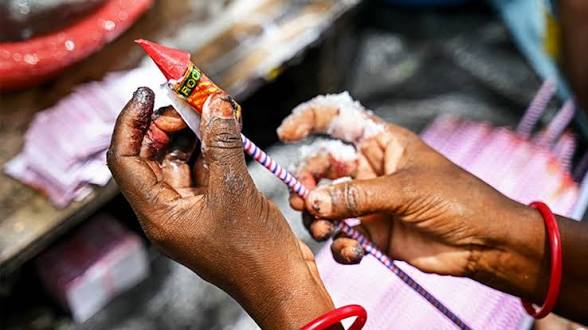
However, hundreds of miles away from the illuminated balconies and festive feasts lies an industry where light begins in total darkness. In the arid flatlands of Tamil Nadu, particularly the town of Sivakasi, as well as in informal, unregulated cottage workshops scattered across West Bengal, Uttar Pradesh, and Bihar, the making of firecrackers is not an art of celebration—it is a daily, perilous gamble with life itself. For the men, women, and often teenagers who handle raw pyrotechnic chemicals, the sparklers that delight a child elsewhere are born from an environment where a single misplaced friction point, a stray static charge, or an overheated iron roof can trigger catastrophic death.
Sivakasi: India’s Pyrotechnic Engine
To understand the scale of Diwali’s fireworks economy, one must look at Sivakasi, an industrial hub in southern Tamil Nadu responsible for roughly 80 to 90 percent of India’s domestic fireworks production. Originally an arid region unsuited for agriculture, Sivakasi transformed in the mid-twentieth century into the nation’s print, match, and fireworks capital. Today, the town operates as a labyrinth of licensed chemical units, drying grounds, and countless unlicensed, informal satellite workshops hidden in residential alleyways.
Every year, between July and October, the tempo in Sivakasi reaches a fever pitch. Orders flood in from distributors nationwide, pushing factories to maximize output before logistics deadlines close in. Tens of thousands of workers report to shed-like structures before dawn, their hands staining yellow, gray, and silver from direct contact with raw potassium nitrate, sulfur, aluminum powder, barium nitrate, and carbon.
Despite progressive labor laws on paper, the pyrotechnic industry relies heavily on piece-rate wages. Workers are paid not for the hours they endure, but for the number of crackers rolled, filled, or fused. This economic reality creates a deadly incentive: speed often supersedes safety. In the race to pack one more batch of aerial shells or roll another hundred explosive strips, standard protocols—such as grounding tools against static electricity, wearing protective respirators, and strictly measuring chemical limits—frequently erode under pressure.
The Invisible Hazard: Toxic Chemistry and the Threat of Static
The dangers in fireworks manufacturing are twofold: the chronic, slow poisoning of daily exposure, and the sudden, violent finality of an explosion.
Long before a spark ever ignites, workers face severe occupational health hazards. Pyrotechnic mixtures consist of oxidizers, fuels, and chemical colorants that are inherently toxic. Inhaling fine aluminum and sulfur dust over years leads to debilitating respiratory illnesses, including chronic bronchitis, silicosis-like lung fibrosis, and asthma. Heavy metal salts like barium—used to create bright green flares—can induce cardiac complications, neurological tremors, and muscle weakness. Because many small-scale units lack proper ventilation or adequate personal protective equipment (PPE), workers often wrap simple cotton cloths around their faces, which offer virtually zero protection against microscopic chemical particles.
Yet, it is the acute risk of combustion that looms most heavily over every shift. Explosive powder formulations are extremely sensitive to heat, friction, impact, and static electricity. During the scorching pre-monsoon and post-monsoon months, ambient temperatures inside tin-roofed sheds can soar well past 40°C (104°F). Under such heat, chemical volatility spikes.
Static electricity, often dismissed in everyday life, becomes a lethal weapon in a fireworks unit. A worker wearing synthetic clothing or shuffling dry rubber slippers across a dusty floor can generate enough static voltage to ignite a tray of fine aluminum powder or black powder. When a container ignites in a confined space, the result is not a simple burn; it is a supersonic deflagration or detonation. Flash fires consume entire rooms in fractions of a second, destroying structural supports, collapsing roofs, and leaving workers with fourth-degree burns across their entire bodies.
The Shadow Economy of Subcontracting
While organized, licensed factories in Sivakasi are subject to inspections by the Petroleum and Explosives Safety Organisation (PESO) and local labor departments, enforcement faces massive hurdles. Over the decades, rising regulations, stricter emissions rules, and intermittent bans on traditional chemical formulations have driven much of the production underground.
To bypass strict safety caps on the volume of gunpowder allowed in a single room, some licensed operators resort to “subcontracting.” They farm out the most dangerous manual tasks—mixing hazardous chemicals and inserting fuses—to unmonitored home-based workshops. In these rural dwellings, living rooms and courtyards double as makeshift assembly lines.
Here, safety measures are non-existent. There are no lightning arresters, no fire-resistant walls, no chemical showers, and no fire extinguishers. Whole families, including elderly relatives and young dependents, sit on woven mats packing incendiary compounds into paper tubes while domestic gas stoves burn nearby. When an explosion occurs in these residential pockets, the destruction is rarely confined to the worker; it routinely flattens adjacent homes, killing neighbors, children, and passersby.
Why Workers Return to the Flashpoint
A fundamental question often asked in the wake of recurring factory tragedies is simple: why do people continue to do this work?
The answer lies squarely in systemic rural poverty and regional geography. In arid districts like Virudhunagar, persistent droughts and depleted water tables have rendered traditional farming financially unviable. Agricultural laborers face chronic seasonal unemployment, with few alternative industrial jobs that do not require specialized education.
The fireworks trade provides immediate, cash-in-hand employment. For an impoverished household, the ability to earn daily wages—even if meager and tied to high-risk quotas—means food on the table, school fees, and the repayment of high-interest local debts. Many workers are bound through informal debt-traps, receiving advances from factory owners or middlemen that require months of labor to repay. Thus, the choice to handle lethal oxidizers without gloves is rarely a choice made freely; it is an economic mandate driven by the need for survival.
The Search for Reform and the Road Ahead
The plight of fireworks laborers has not gone entirely unnoticed. In recent years, India’s Supreme Court has stepped in with significant interventions, mandating the transition to “green crackers”—formulations developed by the Council of Scientific and Industrial Research (CSIR-NEERI) that eliminate toxic heavy metals like barium, utilize cleaner binders, and release 30 percent less particulate matter.
Furthermore, courts and human rights groups have pushed for strict crackdowns on illicit child labor and the enforcement of automated mechanical mixing systems to remove human hands from direct contact with raw friction-sensitive powders.
However, transitioning an entire informal ecosystem is slow. Mechanization requires capital investment that smaller manufacturers resist, while developing stable chemical alternatives that match the sound and brilliance of traditional crackers remains an ongoing scientific hurdle. Meanwhile, regulatory crackdowns often push marginal workshops deeper into secrecy, where safety standards deteriorate even further.
When the night of Diwali arrives, cities erupt in an unforgettable display of luminescence. Children cheer as rockets trace golden arcs against the autumn sky, and communities gather in shared celebration of renewal, light, and prosperity.
Yet, honoring the festival’s true spirit requires acknowledging its human cost. The brilliant flashes that illuminate metropolitan skies are forged through the sweat, toxic exposure, and perilous vulnerability of workers who risk their lives for modest daily earnings. Ensuring rigorous enforcement of labor safeguards, universal adoption of automated safety standards, fair compensation, and viable alternative livelihoods is not merely a legal or technical necessity—it is a moral imperative. Only when the production of light ceases to cost human lives can the festival truly symbolize the triumph of darkness over despair.
About The Author