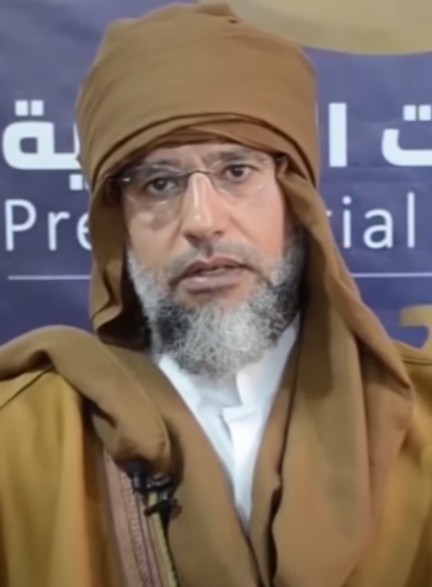
His name meant “Sword of Islam,” yet for much of his adult life, Saif al-Islam Gaddafi tried to convince the world that he was a man of the pen, the paintbrush, and the diplomat’s handshake. Cultivated in London salons, speaking fluent English, and clothed in bespoke European tailoring, he was long groomed to be the modern, acceptable face of an eccentric and brutal police state. But when the winds of the Arab Spring tore across North Africa in 2011, the cosmopolitan veneer shattered.
On February 3, 2026, in the rugged western mountain redoubt of Zintan, that contradictory life was violently extinguished at the age of 53. Four masked gunmen infiltrated his walled villa, disabled the security surveillance, and shot him dead in his private garden. His death marks not merely the violent conclusion of an individual’s personal saga, but the final, bloody closing of the book on the Gaddafi dynasty’s half-century hold over Libya’s political imagination.
The Prince of Reinvention
Born in 1972 inside Tripoli’s fortress-like Bab al-Aziziya compound, Saif was the second and favored son of Muammar Gaddafi. While his brothers drifted into the regime’s military elite, reckless soccer careers, or criminal racketeering, Saif was positioned as something rare in the Arab authoritarian world: a philosopher-prince.
He studied architecture in Tripoli, pursued management studies in Vienna, and eventually secured a doctorate from the prestigious London School of Economics in 2008. Saif embedded himself deep inside Western high society. He vacationed with billionaires, hobnobbed with European royalty, hosted lavish birthdays in Montenegro, and maintained ties to influential Western thinkers and politicians.
To Western governments desperate for Libyan crude and eager to neutralize a rogue regime, Saif was a godsend. Through his philanthropic vehicle, the Gaddafi International Charity and Development Foundation, he served as the regime’s chief emissary to the outside world. He brokered the compensation deals for the 1988 Lockerbie bombing victims, negotiated the release of the Bulgarian nurses falsely accused of infecting Libyan children with HIV, and persuaded his father to dismantle Libya’s covert nuclear weapons program in 2003.
Domestically, he presented himself as the standard-bearer of “Libya Tomorrow,” a reformist project that founded independent newspapers, advocated for a permanent written constitution, and released hundreds of imprisoned Islamist dissidents. For nearly a decade, Western capitals and educated Libyans convinced themselves that Saif was an authentic bridge to a democratic, post-despotic future.
The Mask Slips
The illusion dissolved overnight in February 2011. As protests erupted across Benghazi and Tripoli, the reformer vanished, replaced by the regime’s most belligerent defender.
Appearing on state television in a dark blazer, gesticulating wildly with his forefinger, Saif al-Islam addressed the Libyan people not with promises of civil liberties, but with apocalyptic threats. He warned of civil war, rivers of blood, and the total destruction of the state if his father’s rule was challenged. “We will fight to the last minute, to the last bullet,” he raged.
That single broadcast alienated his international patrons and cemented his status in the eyes of Libyan revolutionaries as an existential enemy. It was not reform he had championed, critics realized, but dynastic preservation. Within months, the International Criminal Court (ICC) issued an arrest warrant for Saif, indicting him for crimes against humanity, specifically the murder and persecution of peaceful demonstrators.
When Tripoli fell in August 2011, Saif fled south. His father was cornered and brutally killed in a drainage ditch in Sirte that October. Saif attempted to escape across the Sahara into Niger, but was intercepted in November 2011 by a local brigade from Zintan. Photographed with his right hand heavily bandaged—several fingers severed by a recent airstrike—the globe-trotting intellectual had been reduced to a desert captive.
The Ghost of Zintan
The decade that followed was an exercise in surreal political theater. While a Tripoli court sentenced him to death by firing squad in absentia in 2015, the Zintan militia that held him refused to surrender him to the capital, nor would they hand him over to The Hague. Saif was their ultimate political insurance policy.
By 2017, as post-revolutionary Libya devolved into a patchwork of competing warlords, tribal rivalries, and rival governments, Saif was granted an official amnesty by eastern-based authorities. He was quietly released from captivity, but he never truly left Zintan. Instead, he retreated into the shadows, living in guarded villas, protected by a mix of local loyalists and tribal fighters.
From that subterranean existence, Saif became a ghost who haunted Libyan politics. Amid the collapse of the central state, runaway inflation, endless power outages, and militia terror, a wave of nostalgia began to wash over sections of the population. For those exhausted by perpetual chaos, the Gaddafi era was recast not as an era of terror, but as a period of stability, subsidized bread, and sovereign pride. Saif positioned himself as the sole custodian of that lost order.
The Fateful Gambit
In November 2021, Saif al-Islam made his dramatic return from the political dead. Dressed in the traditional brown robes and turban famously worn by his father, he walked into an electoral commission office in the southern city of Sabha to register his candidacy for the Libyan presidency. With his graying beard, wire-rimmed glasses, and missing fingers, he looked less like an international jet-setter and more like an austere desert mystic.
His candidacy detonated what fragile consensus existed. Armed groups in Tripoli besieged electoral offices; legal petitions challenged his eligibility; and foreign powers scrambled to prevent an outcome that would humiliate the 2011 intervention. The entire presidential election collapsed under the weight of his name, postponing the vote indefinitely and deepening Libya’s partition.
Yet Saif refused to step aside. As renewed efforts emerged to organize elections, polling consistently demonstrated that he maintained a stubborn, dangerous baseline of support across southern tribes and former regime strongholds. He had no formal military force of his own, but his symbolic currency remained uniquely volatile.
That volatility made him impossible to ignore—and intolerable to the rival power brokers dominating Tripoli, Benghazi, and Tobruk. To the armed factions of the west, he remained a bloodstained war criminal; to rival eastern leaders, he was a populist spoiler threatening their monopoly on the state.
An Inevitable Demise
The fatal intrusion on February 3, 2026, possessed all the hallmarks of a professional assassination. The disabling of cameras, the brazen daylight entry into his compound, and the silent getaway left little doubt that his presence had become an unacceptable complication for someone in Libya’s armed elite.
His burial in Bani Walid—a historic bastion of Gaddafi loyalty—drew thousands of mourners waving green flags. Yet the tragedy of Saif al-Islam Gaddafi lies in the stark chasm between what he believed he represented and what he actually achieved.
He envisioned himself as Libya’s savior: the one man capable of uniting tribal tradition with modern governance. In reality, his life was defined by fatal self-deception. When tested, he abandoned the liberal ideals he had championed in Europe to defend the autocratic family enterprise. He lived as a fugitive in the country his family once owned, and died by the very lawlessness unleashed when the state his father built imploded. With his death, the Gaddafi political project is finally buried, leaving behind a nation still searching for a way out of the ruins.
About The Author