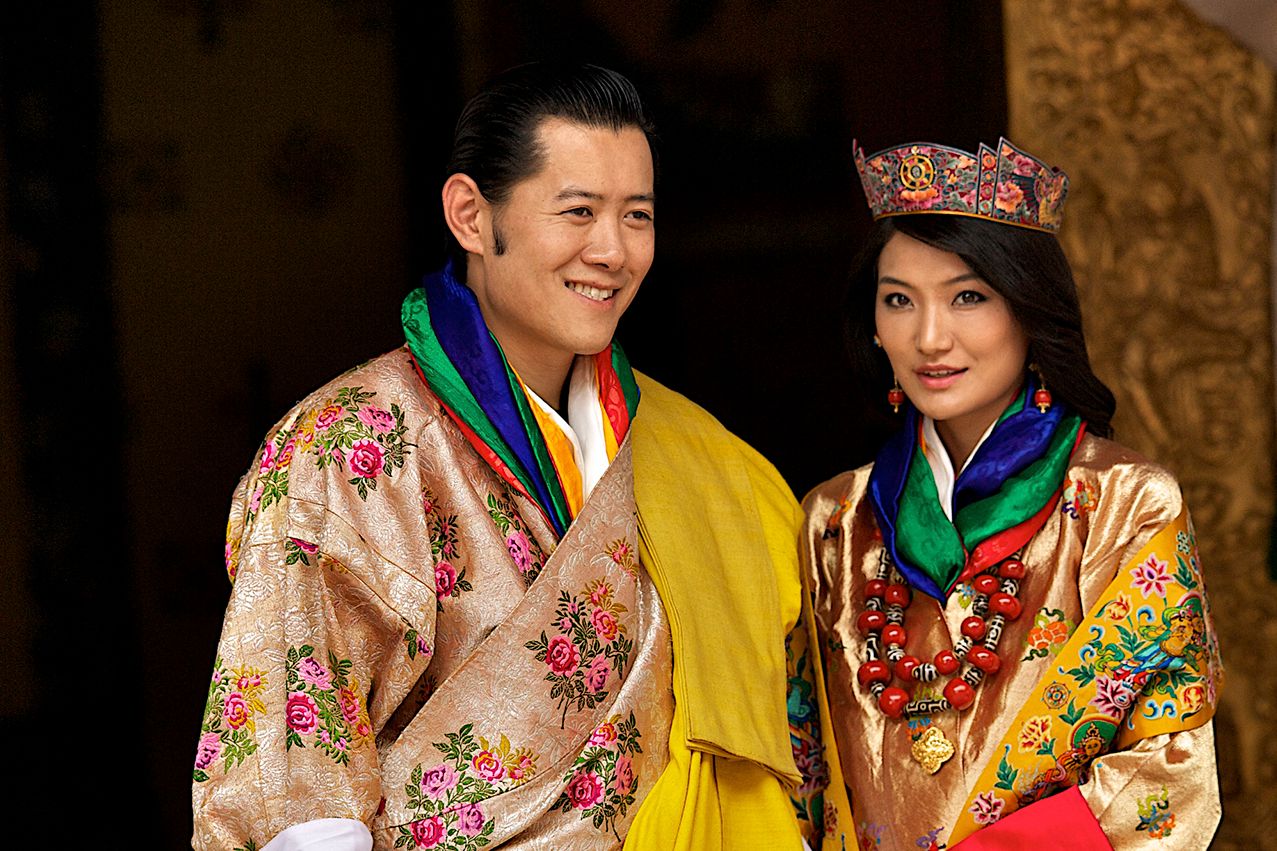
In October 2011, amid the fortress walls and mist-shrouded valleys of the Punakha Dzong, the Kingdom of Bhutan witnessed an event that straddled centuries of sacred tradition and the quiet dawn of a modern era. The fifth Druk Gyalpo, or “Dragon King,” Jigme Khesar Namgyel Wangchuck, took Jetsun Pema as his queen. The ceremony was rich with ancient Buddhist rites, swirling silk brocades, and masked dances. Yet beneath the pageant of dynastic ritual lay a personal and political declaration that reverberated far beyond the Himalayas: the young monarch announced that he would never take another wife.
In a kingdom where royal polygamy had long served as a bedrock of statecraft, alliance-building, and religious consolidation, King Jigme Khesar’s choice was nothing short of revolutionary. By publicly renouncing the historic royal prerogative to wed multiple women, the fifth monarch redefined the Bhutanese crown, reframed traditional notions of power, and established a modern moral standard for a nation undergoing a deliberate, historic transition into democracy.
The Legacy of Dynastic Polygamy
To understand the weight of King Jigme Khesar’s refusal, one must examine the role polygamy played in Bhutanese history. For centuries, the mountainous kingdom operated under a delicate balance of regional chieftaincies, monastic factions, and noble lineages. Strategic marriages were not matters of romantic whim; they were structural necessities designed to avert civil strife and unify disparate valleys divided by impenetrable geography.
This tradition reached its pinnacle during the reign of Jigme Khesar’s father, Jigme Singye Wangchuck, the revered fourth Dragon King. In 1988, King Jigme Singye Wangchuck participated in an official public wedding ceremony that cemented a legendary union: he wed four sisters—Dorji Wangmo, Tshering Pem, Tshering Yangdon (the fifth King’s mother), and Sangay Choden.
These four queens were not merely royal consorts; they were direct descendants of the Shabdrung Ngawang Namgyal, the unifier of Bhutan, and the revered Mindrolling lineage of Tibetan Buddhism. By marrying all four sisters, the fourth king bound the royal house of Wangchuck to the spiritual and historic soul of ancient Bhutan, harmonizing temporal authority with monastic lineage. The arrangement brought profound stability, produced royal heirs, and was embraced by the Bhutanese populace as an act of profound statesmanship that preserved national harmony.
Polygamy and polyandry were neither uncommon nor stigmatized in traditional Bhutanese custom. Across various pockets of the eastern Himalayas, marital customs were flexible, pragmatically adapted to labor needs, land inheritance, and clan alliances. When King Jigme Khesar ascended the throne following his father’s voluntary abdication in 2006, the expectation—spoken or unspoken—remained that he would maintain the royal customs that had kept the dynasty secure.
The Announcement at the National Assembly
In May 2011, during the opening of the seventh session of Bhutan’s Parliament, the 31-year-old monarch addressed his ministers and citizens. He was an Oxford-educated ruler, widely celebrated for his humility, who had spent his youth walking village to village across Bhutan to meet farmers, herdsmen, and students.
Breaking with the practice of his ancestors, the King spoke not of political alliances or ancestral heritage, but of personal character and enduring devotion. Introducing Jetsun Pema—a commoner by constitutional standard, despite noble heritage, and a student ten years his junior—the King described her not simply as a prospective queen, but as a companion of shared spirit:
“She is a wonderful human being, intelligent. She and I share one big thing in common: a love and passion for our country.”
Then came the definitive declaration that broke centuries of royal precedent: the King made it known that Jetsun Pema would be his only wife, stating explicitly that he would never take another woman in marriage.
In a world where monarchs frequently hide behind ambiguous palace pronouncements, the statement was unequivocal. It was not framed as a critique of his father or ancestors, but as an evolution of values appropriate for a new Bhutan.
Redefining the Monarchy in a Democratic Era
King Jigme Khesar’s choice cannot be viewed in isolation from the broader democratic transformation of Bhutan. In 2008, under the direct stewardship of both the fourth and fifth kings, Bhutan enacted its first formal constitution, transitioning from an absolute monarchy to a constitutional, parliamentary democracy.
The crown recognized that a 21st-century monarchy could no longer derive its legitimacy from feudal alliances or sprawling royal households. Instead, legitimacy had to stem from service, transparency, and exemplary personal conduct. By choosing monogamy, the King aligned the institution of royalty with the everyday realities of modern Bhutanese citizens.
A royal family with multiple queens inevitably generated expansive royal courts, complex patronage networks, and potential succession rivalries. In an era where Bhutan was institutionalizing a lean, meritocratic civil service and a constitutional government, a single, unified royal household presented an image of stability and fiscal prudence. King Jigme Khesar and Queen Jetsun Pema chose to live in a modest cottage in Thimphu rather than the expansive royal palaces, reinforcing the narrative that the crown was an instrument of service rather than dynastic excess.
A Quiet Cultural Shift: Gender and Modernity
Bhutan has historically afforded women higher social standing and legal protections than many of its South Asian neighbors. Traditional Bhutanese law frequently favors daughters in inheritance, with land and ancestral homes passing through matriarchal lines. However, royal polygamy had long maintained an asymmetrical dynamic, signaling that plural marriage was an elite masculine privilege.
When King Jigme Khesar chose a single lifelong partner, he delivered a powerful social message regarding marriage as a true partnership of equals. In public appearances, the King and Queen presented a dynamic unfamiliar to traditional court life: holding hands, walking side by side, and displaying gentle, open mutual affection.
For Bhutan’s burgeoning youth demographic, this public partnership became an aspirational model of modern romance grounded in mutual respect. It signaled to the younger generation that tradition is not an unbending monolith; it can evolve to honor core cultural values while discarding outdated patriarchal structures. The King’s commitment gave moral backing to a society steadily moving away from polygamous arrangements toward monogamous partnerships.
The Dragon Queen’s Enduring Dignity
Central to the success of this royal shift was Queen Jetsun Pema herself. Entering royal life at just 21 years old, she assumed the role of Druk Gyaltsuen (Dragon Queen) with quiet grace and unyielding poise. Rather than functioning as a ceremonial ornament, she took on active leadership roles in national health, environmental conservation, and the Bhutan Red Cross Society.
Together, the royal couple transformed the monarchy into an active, approachable institution. In 2016, the birth of their first son, Crown Prince Jigme Namgyel Wangchuck, followed by the arrival of their second son in 2020 and a daughter in 2023, completed the picture of a stable, close-knit family. The succession was clear, unambiguous, and celebrated across all twenty districts of the country.
Tradition Reconciled with Progress
The story of the King of Bhutan refusing multiple wives is not merely a tale of royal romance; it is a case study in conscious leadership. King Jigme Khesar demonstrated that true respect for culture does not require blind obedience to obsolete customs.
By honoring his father’s legacy while respectfully setting aside the practice of royal polygamy, the King preserved the integrity of the monarchy while steering it toward the future. In choosing a single queen, the Dragon King gave his country something more enduring than a political alliance: he provided a living example of fidelity, equality, and modern leadership, proving that progress and heritage can walk hand in hand.
About The Author